Technical notes · XActant 48 V DC servo drives
48 V DC servo drives, force control, and the engineering behind them
I am Jintao Chen, a sales engineer at XActant. On this site I write about low-voltage DC servo drives the way I would explain them to a colleague at the bench: current-based force control, current-loop design, encoder integration, EtherCAT timing, and the practical differences between a 48 V DC architecture and the 380 V AC servo platforms most competitors ship. Everything here is written from engineering practice, and every number comes from a published product specification.
Start here
How current-based force control actually works
Why measuring motor current is a different thing from measuring force, and what that difference buys you in a soft-landing application.
Parameter quick reference
Voltages, current ratings, encoder protocols, temperature ranges and the communication options each drive supports.
EtherCAT cycle time, 4 kHz vs 40 kHz
Two different numbers that are easy to confuse: bus cycle time and current-loop frequency. Here is which one your axis actually depends on.
What “10 grams” really means
Where the industry publishes 10 g soft-landing figures, what is measured, and how a direct-current architecture reaches the same number differently.
Application notes
Die attach, pick-and-place, IVD pipetting, optical focus, grippers and linear stages — mapped to the motion pattern each one needs.
Documents
Cable selection, force-control application notes, brake and regeneration guides, safety precautions and host software.
The four interface options on one board
The UF platform is the part I recommend most often for contact-type applications on a 48 V bus. The mechanical core is the same across all four variants; what changes is the interface board. That is why the current-loop behaviour — the thing that decides soft-landing repeatability — does not change when you switch bus type.
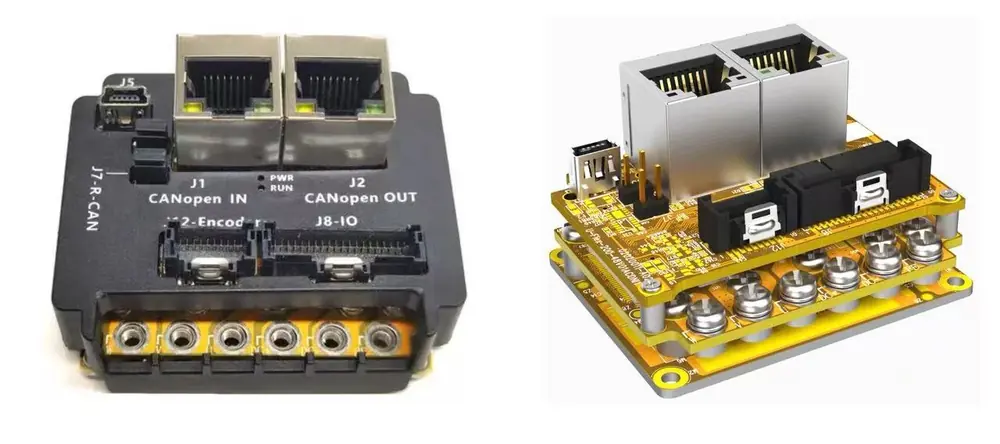
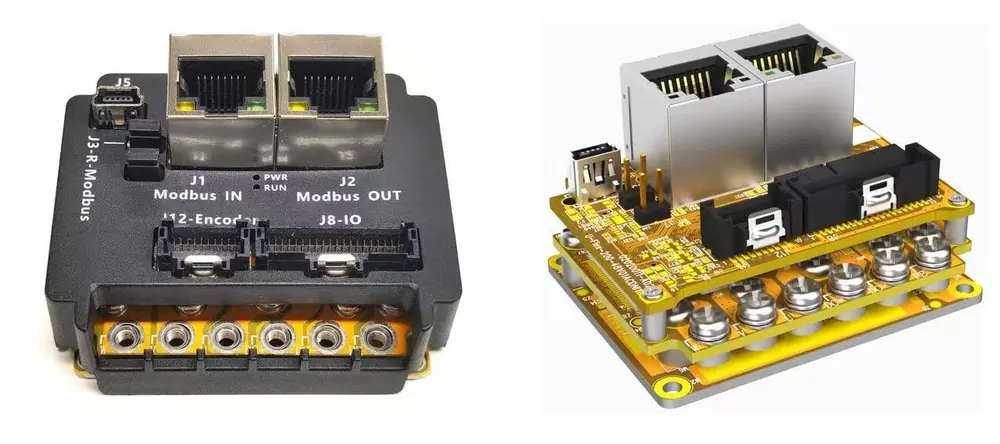
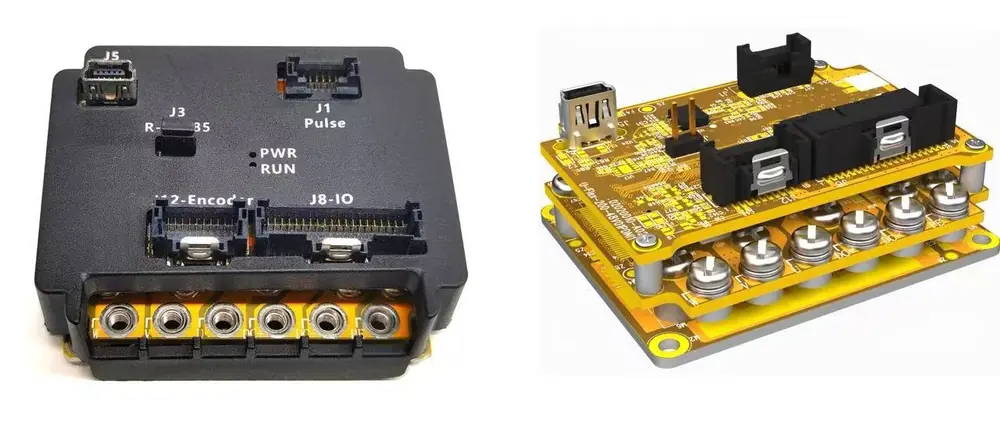
The same UF-48Vxx 48 V DC servo drive with EtherCAT, CANopen, Modbus and pulse/direction interface boards. EtherCAT variants add STO; the other three do not.
Full ordering codes run
UF-48V{01,03,06,10,15,20,28}AED{R,N}{,-P}. The -P suffix is the
force-control version with 0.1 g resolution and 16-bit current sampling.
See the full parameter reference →
What I work on
XActant builds low-voltage DC servo drives — 24 to 48 VDC nominal, with EtherCAT, CANopen, Modbus and pulse/direction interfaces, plus embedded drive cores for manufacturers who build their own motion controller. The company ships around 100,000 units a year. My work is the part where a customer describes a motion problem and someone has to work out which architecture actually solves it.
Two things worth knowing before you compare drives
1. A 48 V DC bus is not a downgrade from 380 V AC
Several competitors publish 10 g soft-landing performance. Their 10 g figures come from AC servo platforms and voice-coil actuators. Ours comes from controlling motor current directly on a 48 V DC bus. The difference is not marketing language — an AC servo drive typically controls torque through a current loop running at kilohertz rates, while a DC bus drive can run that loop an order of magnitude faster and measure force at the source. If your process depends on soft contact, that architectural difference is the thing to evaluate, not the brand on the label.
2. Force control is not a robot feature
The applications that benefit from current-based force control are contact applications: semiconductor die attach and placement, optical focus systems, IVD pipetting, electric grippers, linear stages, and panel handling. If your machine does not touch something, you probably do not need force control — you need position control, and you should judge the drive on repeatability and tuning instead. I would rather tell you that than sell you the wrong feature.