Home / Insights / “10 g” is not a differentiator
Technical note
“10 g” is not a differentiator
If your shortlist has several suppliers all quoting 10 g contact force, you should not treat that number as the reason to choose one of them. It is credible evidence that the supplier can do gentle handling — and it separates nothing else. Here is what does.
Several established suppliers publish 10 g
MRSI Systems quotes forces as low as 10 grams. SMAC's Soft-Land trademark is described as gentle touch at 10 g. At least one competitor publishes an even finer figure. If your evaluation sheet has “10 g” in the comparison column, that column separates nothing. I want to be direct about this on our own products too. We publish contact force typically around 10 grams with roughly ±1 gram variation, and the high-performance-P version offers finer force resolution at 0.1 g. The number is in the same range as everyone else's in this space. I am not going to claim a better figure than the competition, because claiming it would not be true.
What does separate suppliers is the mechanism
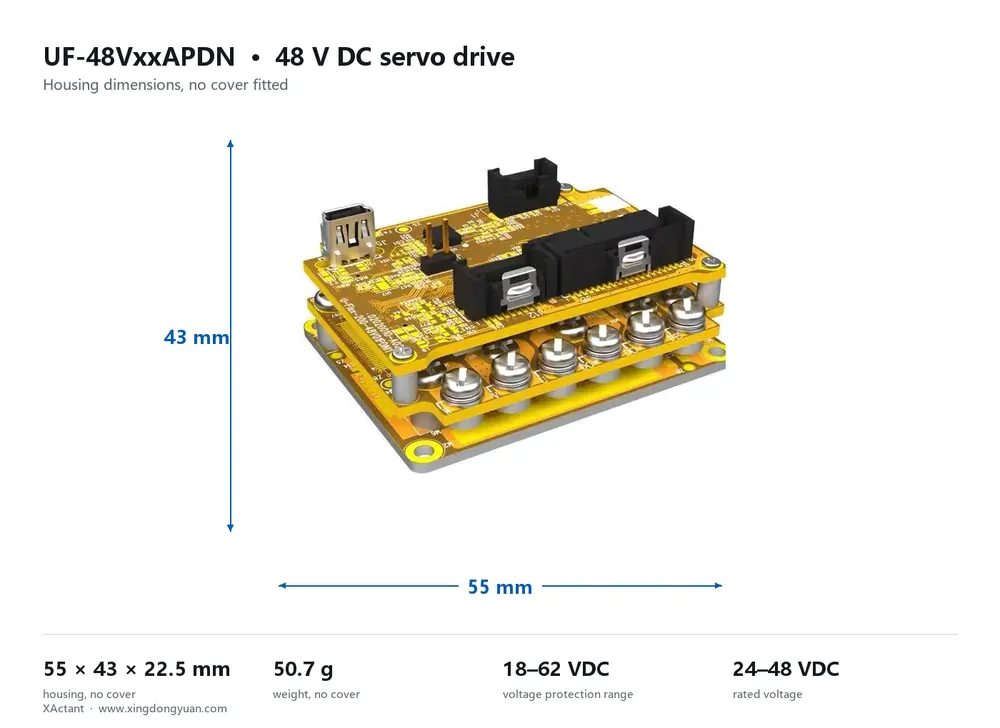
These 10 g figures are reached on AC servo platforms and on voice-coil actuators. The drive regulates current on a 48 V DC bus instead, and force control is a firmware function of the drive rather than a separate loop around an external sensor. The practical consequences for a machine:- The force signal inherits the current loop's bandwidth — 20 kHz, maximum 40 kHz — rather than a sensor's bandwidth and filtering latency.
- Force production is a property of the drive you already have to buy, so there is no additional sensor to specify, mount, cable, calibrate and eventually replace.
- Because the sensing is inside the drive, the behaviour depends on correct firmware configuration and on the drive's current-loop performance — a real trade-off, not a free win.
The honest way to put it
The number is the same. What can be shown is the method, and the documentation that lets your own engineer check the behaviour on your workpiece rather than take a figure on trust. If you are comparing a voice-coil solution against a servo solution, the comparison is not 10 g against 10 g — it is two different machine architectures with different cost, different stroke, different positioning behaviour and different failure modes. A servo drive that produces the same gentle touch over a longer stroke is often the better machine, and a voice coil may still be right when the stroke is short and the cycle time dominates. The force figure is one line in that comparison, not the comparison.The one question that does most of the work
When you put a question to any supplier in this space, ask how the force is produced — is it by controlling motor current, or by a sensor mounted between the tool and the part? That single question separates most of the shortlist, and it is a question a supplier can answer precisely. The follow-up is just as useful: what does the force signal look like at the moment of contact on my part? Any supplier who has looked at a real contact event will have an opinion. If the answer is only a number from a datasheet, the number is not describing your machine.Key takeaways
- 10 g is credible evidence of gentle handling but separates no suppliers — put it in the specification table, not in the headline.
- The mechanism is the real comparison: current regulation on a 48 V DC bus versus an external sensor loop around an AC servo or voice-coil actuator.
- Ask how force is produced and what the force signal does at contact on your own workpiece — a datasheet number alone will not decide it.
Common questions
Is a 0.1 g force resolution better than a 10 g specification?
They measure different things, and they are not interchangeable. A typical contact force figure describes the level the drive holds, with a tolerance around it. A 0.1 g resolution describes the finest change in force the drive can command or detect. The 0.1 g figure belongs to the high-performance -P variant. You need both a target level and a resolution to specify a process properly.
Should I choose a voice-coil actuator instead?
Sometimes, yes. A voice-coil actuator is excellent when the stroke is short and cycle time dominates. A servo drive becomes the better answer as stroke grows, as multiple axes need coordinated motion, or when you want positioning behaviour and not just force. Send me the stroke, the cycle time and the payload and I will tell you which one I would pick.
Does the same 10 g figure mean the same thing across suppliers?
It often does not. Some figures describe the commanded setpoint, some describe a measured peak, some describe a steady-state hold with tolerance, and some are measured at a specific point in the tooling rather than at the part. Always ask what was measured, where it was measured, and over what dwell time.