Home / Parameters
Reference
48 V DC servo drive parameter quick reference
Published specifications for the XActant low-voltage DC servo range, with the decision points I normally work through with a customer before a model gets chosen. Every figure below comes from the relevant product manual or specification sheet.
UF series — 48 V flagship
The UF series is the part I recommend most often for contact-type applications on a 48 V bus.
It is available with force control in a dedicated -P version, which adds finer
force resolution and a 16-bit current sampling path.
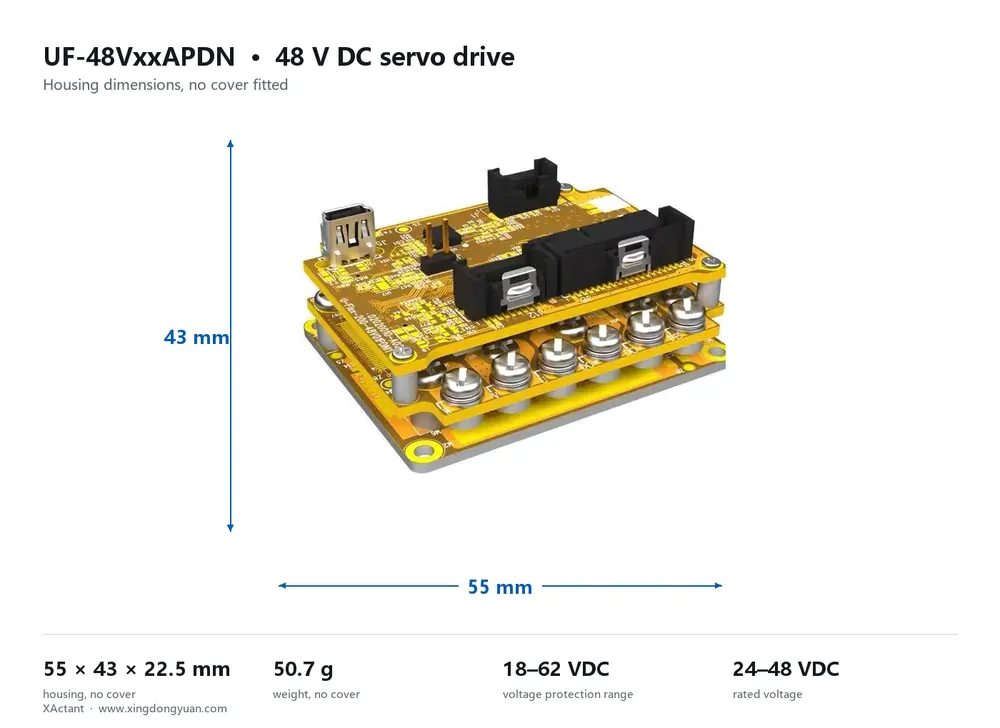
UF-48VxxAPDN — 55 × 43 × 22.5 mm, 50.7 g, housing with no cover fitted. This is the smallest mechanical version in the UF range and the one that decides whether the drive fits your enclosure.
Three versions exist and they are not interchangeable: AE is 70 × 50 × 33.91 mm at 90.2 g, AC and AM are 55 × 43 × 31.91 mm at 60.7 g, and AP is 55 × 43 × 22.5 mm at 50.7 g.
| Model | Rated voltage | Rated current | Peak current | Note |
|---|---|---|---|---|
UF-48V01AEDR | 18–62 VDC | 1 Arms | 3 Apeak | EtherCAT, STO |
UF-48V03AEDR | 18–62 VDC | 3 Arms | 9 Apeak | EtherCAT, STO |
UF-48V06AEDR | 18–62 VDC | 6 Arms | 18 Apeak | EtherCAT, STO |
UF-48V10AEDR | 18–62 VDC | 10 Arms | 30 Apeak | EtherCAT, STO |
UF-48V15AEDR | 18–62 VDC | 15 Arms | 45 Apeak | EtherCAT, STO |
UF-48V20AEDR | 18–62 VDC | 20 Arms | 60 Apeak | EtherCAT, STO |
UF-48V28AEDR | 18–62 VDC | 28 Arms | 84 Apeak | EtherCAT, STO |
UF-48V10AEDN | 18–62 VDC | 10 Arms | 30 Apeak | EtherCAT, no STO |
R = regenerative brake resistor support with STO
· N = no STO · -P = force-control version with 0.1 g resolution and
16-bit current sampling. EtherCAT models use RS485 for commissioning daisy-chaining; the other
interfaces use MiniUSB.Three mechanical versions exist and they are not interchangeable:
| Version | Dimensions | Mass |
|---|---|---|
| UF-…-AE | 70 × 50 × 33.91 mm | 90.2 g |
| UF-…-AC / AM | 55 × 43 × 31.91 mm | 60.7 g |
| UF-…-AP | 55 × 43 × 22.5 mm | 50.7 g |
Full ordering codes run UF-48V{01,03,06,10,15,20,28}AED{R,N}{,-P}. Note that
end-of-jitter suppression is an option, not a standard feature. Ask for it explicitly if your
process depends on it.
DS1 / D series — general purpose
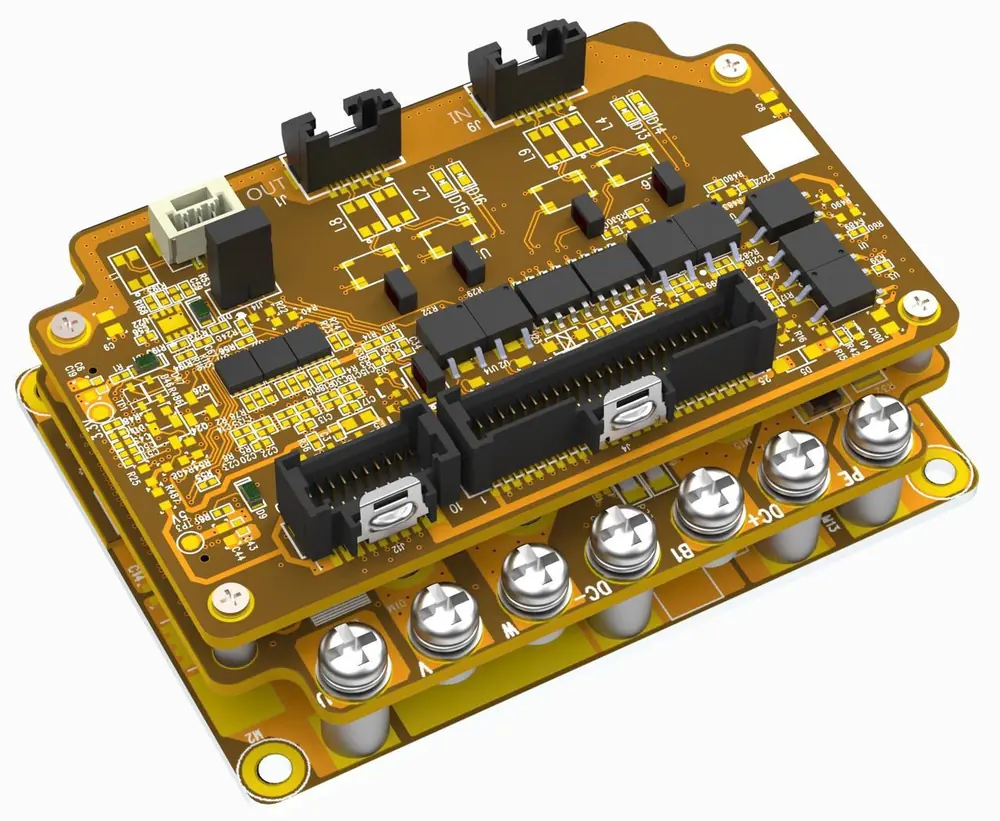
The D and DS series cover 24–48 VDC at 2–20 Arms, with EtherCAT, CANopen, Modbus and pulse/direction. The DS interface board integrates the bus capacitor (no external bus capacitor needed), uses shared compression terminals, and removes the PE screw requirement. Multi-segment trajectory control is built in across the range, which shortens the control loop and makes force control respond faster.
| Model | Voltage protection | Rated voltage | Rated current | Peak current |
|---|---|---|---|---|
DS1-E4802* | 15–60 VDC | 24–48 VDC | 2 Arms | 6 Arms |
DS1-E4806* | 15–60 VDC | 24–48 VDC | 6 Arms | 18 Arms |
DS1-E4810* | 15–60 VDC | 24–48 VDC | 10 Arms | 25 Arms |
DS1-E4820* | 15–60 VDC | 24–48 VDC | 20 Arms | 50 Arms |
Key hardware figures: EtherCAT real-time cycle ≤ 4 kHz · incremental encoder differential
quadrature up to 10 MHz · 4 × isolated digital input at up to 1 MHz (6 mA, 0–5 V, PNP or NPN) ·
2 × isolated digital output at 1 kHz (100 mA, 12–30 V) · 1 × analogue input ±10 V 12-bit, shared
with analogue control · internal common-bus brake supply at 1 A · regenerative braking 48 V / 28 A
max with PWM output · 12-bit current sampling · single-end ABZ and differential ABZ (0–5 V)
equivalent encoder output · MOS transistor temperature monitoring with alarm · operating
temperature 0 to +45 °C, storage −20 to +65 °C · dimensions 81 × 50 × 24.4 mm
(DS1-E48xxx) or 70 × 50 × 25.3 mm (DS1-E48xxxM) · CE, UL, FCC.
DG series — wide temperature
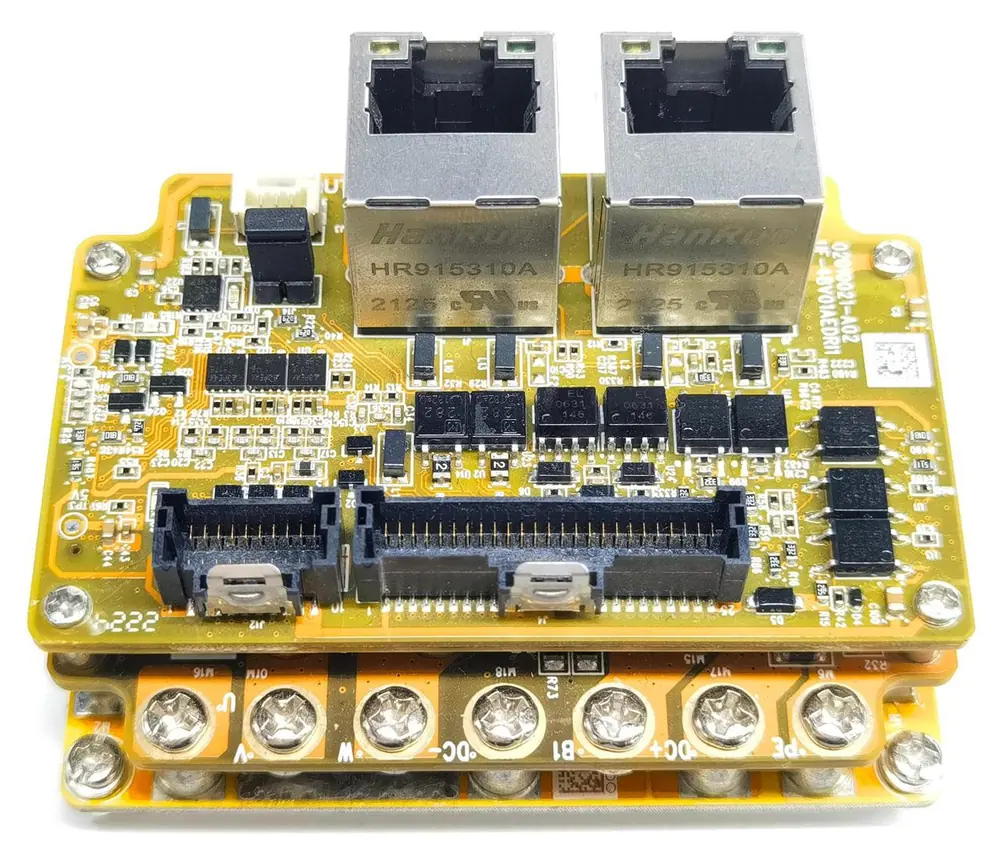
When the cabinet sits next to the machine or the ambient swings hard, the DG series is the right family: −40 to +70 °C operating range with dual encoder support. DG3 also offers the high-performance -P variants with 16-bit current sampling and finer force resolution. Note that DG3's EtherCAT real-time cycle is ≤ 2 kHz, while other EtherCAT models run ≤ 4 kHz — relevant if you are planning a tightly synchronised multi-axis configuration.
G series — embedded drive cores
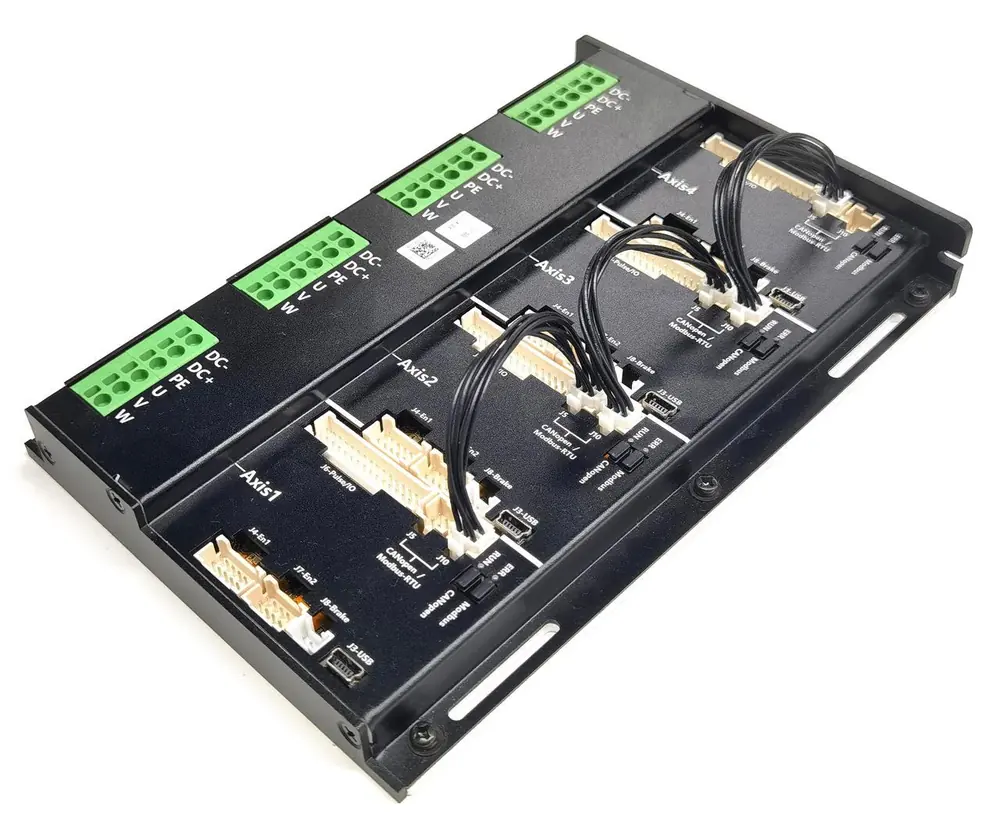
The G series is a different product class: servo drive core modules that a machine
builder integrates into their own controller, rather than standalone drives. Typical ordering
codes are GC1-C48xxN-1D-MT (Modbus), GM1 pulse-type,
GM1-E48xxN-2D-ZR (dual-axis EtherCAT) and GM1-×48xxN-6D-MT6 (six-axis).
For multi-axis machines the six-axis G unit is the mainstream product — DM tops out at four axes
and is limited to −10 to +45 °C.
ZR accuracy figures: rotational ±0.01°, linear ±2 μm repeatability, with cycle times under 50 ms per revolution and under 80 ms per 30 mm of linear travel.
Encoder interfaces
| Type | Supported protocols | Notes |
|---|---|---|
| Incremental | Differential quadrature ABZ, up to 10 MHz | Common across the range |
| Absolute | BiSS-C, SSI, EnDat 2.2, Tamagawa, Nikon | Protocol support depends on the model |
| DR ring (specialised) | EnDat 2.2, BiSS-C, SSI | Dual absolute channels; no incremental option |
| Equivalent output | Single-end ABZ, differential ABZ (0–5 V) | For cascading drive feedback |
The DR ring product is worth calling out: it is a dual-absolute-channel encoder product for ring-type architectures, and it does not offer an incremental variant. If you have been specifying an incremental ring encoder, this is not a drop-in replacement. I have written a longer treatment in choosing an encoder for a low-voltage DC servo drive.
Communication interfaces
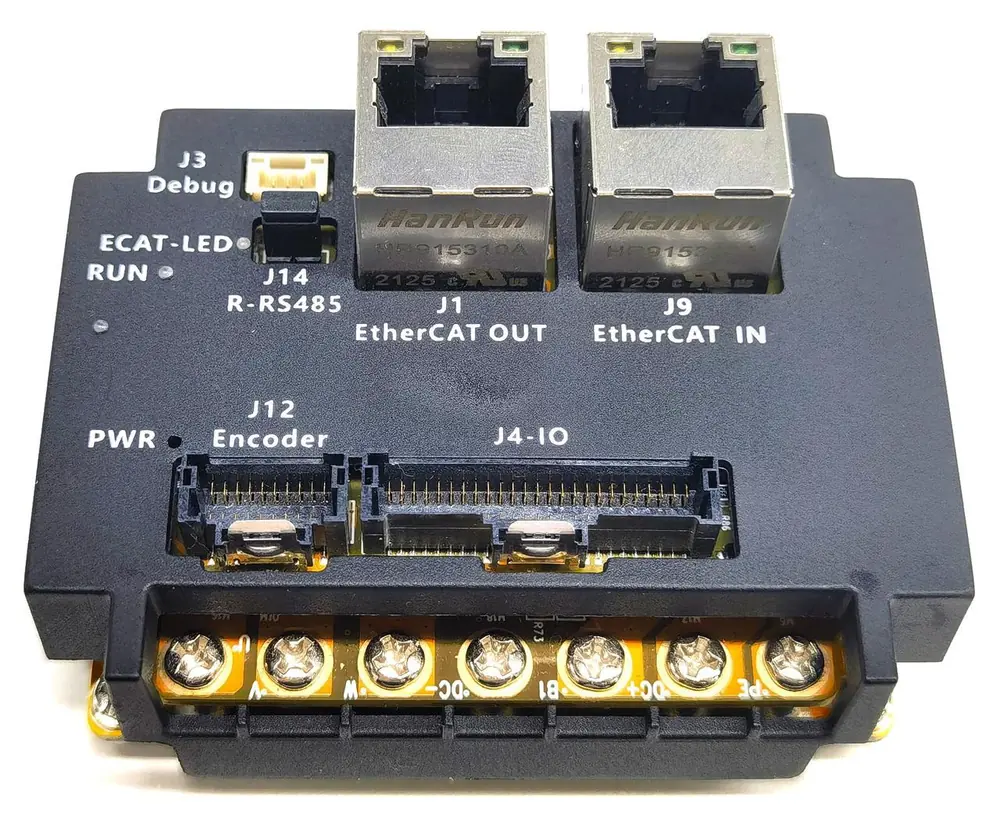
The same mechanical core with four interface boards. The current-loop behaviour — the thing that decides soft-landing repeatability — does not change when you switch bus type, which is why the force specification is identical across all four.
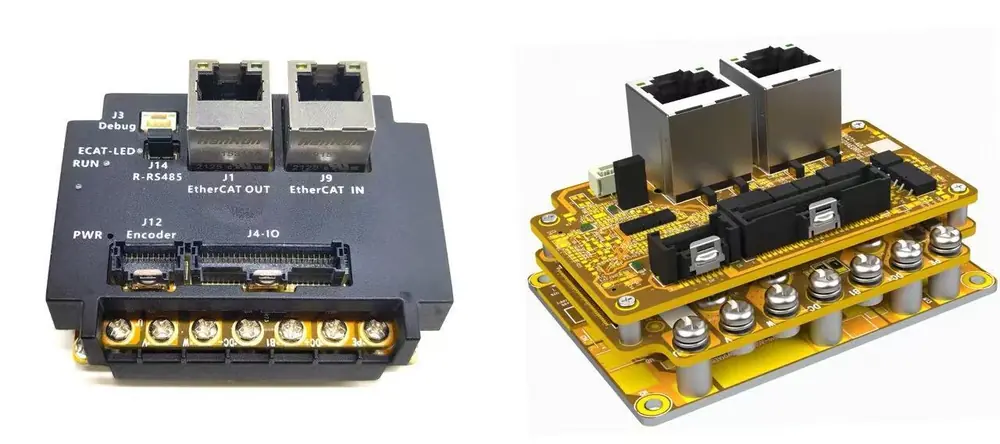
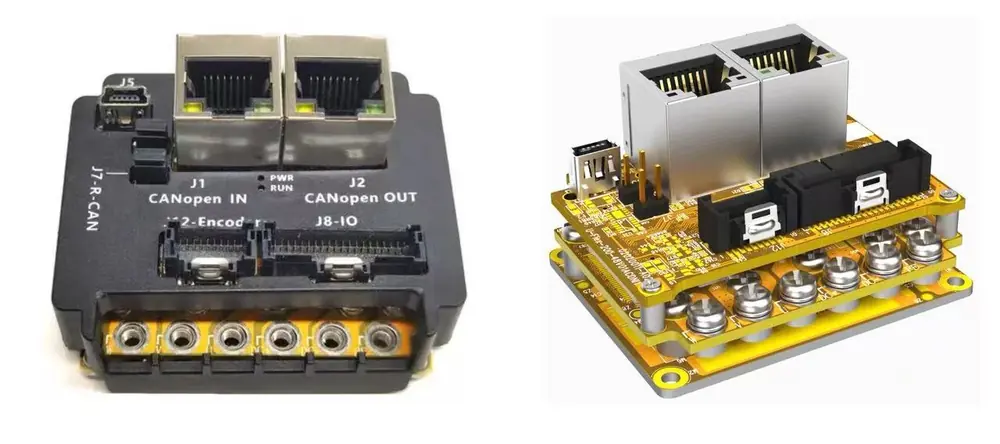
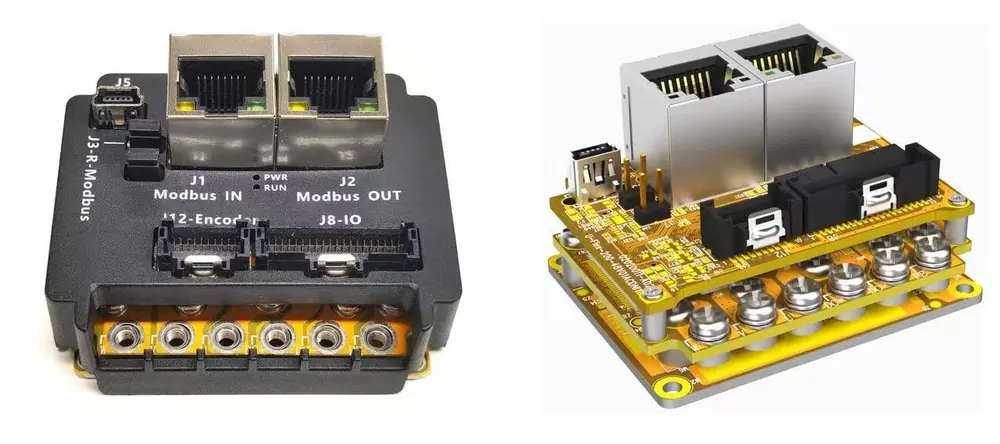
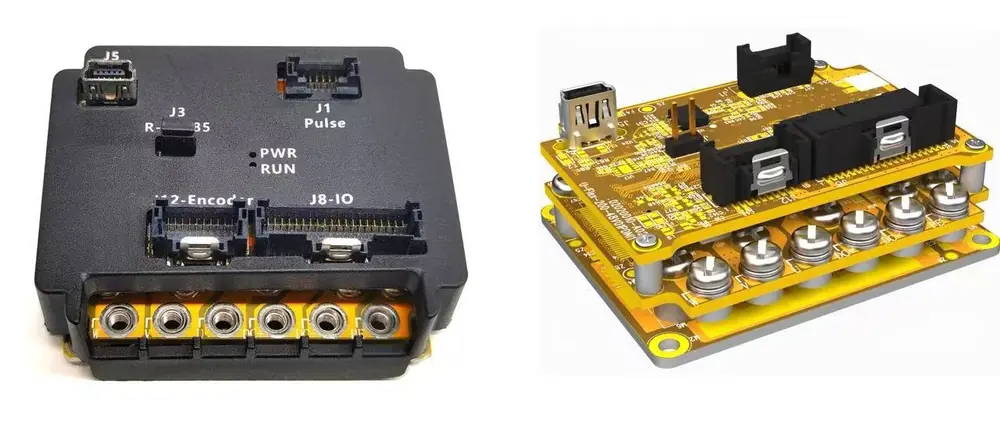
UF-48Vxx with EtherCAT, CANopen, Modbus and pulse/direction interface boards. Each variant has its own page with the full specification.
| Interface | EtherCAT | CANopen | Modbus-RTU | Pulse / direction |
|---|---|---|---|---|
| STO supported | Yes (R-suffix models) | No | No | No |
| Real-time cycle | ≤ 4 kHz (DG3 ≤ 2 kHz) | — | — | — |
If a customer specifies STO together with CANopen, Modbus-RTU or pulse/direction, the honest answer is that the combination does not exist on this platform. We still ship the drive and flag the discrepancy, because in practice it is usually a typo in the specification — but it can also mean the fieldbus type was written down wrong, and that distinction matters for the safety case. The detail is in STO and functional safety.
STO and functional safety
STO is implemented as two inputs and one output: it cuts motor current and disables output
torque. It is available on EtherCAT models with the R suffix. It is not a complete
functional-safety solution on its own — see
the article for what STO does and does not
cover, including where a risk assessment is still required.
Operating temperature by series
| Series | Operating temperature | Comment |
|---|---|---|
| DG series | −40 to +70 °C | Wide-temperature option, dual encoder |
| D / DS series | −40 to +70 °C | Wide temperature available |
| G series | −30 to +50 °C | Core modules for OEM controllers |
| UF series | 0 to +45 °C | Not a wide-temperature part |
Do not quote a wide-temperature range for the UF series. If the ambient is the binding constraint, the DG series is the correct family.
Selection decision tree
- Do you need to control contact force? If no → position control only; judge on repeatability, tuning and bus interface. If yes → continue.
- Which bus? EtherCAT for synchronised multi-axis and for STO. Modbus or CANopen for simple point-to-point. Pulse/direction for retrofit into an existing controller.
- What is the ambient? Above 45 °C or below 0 °C → DG series.
- Building your own controller? → G series core modules, not a standalone drive.
- Which current? Pick by the motor's continuous current first; the drive's peak rating covers acceleration. I will ask you for the motor model rather than guess.
Still unsure? Send me the motor model, the bus type and the stroke or payload and I will tell you which part fits — including when the answer is “you do not need force control for this”.