Home / Insights / Choosing an Encoder for a Low-Voltage DC Servo Drive
Technical note
Choosing an Encoder for a Low-Voltage DC Servo Drive
Choosing an encoder for a low-voltage DC servo drive looks like a protocol decision and is mostly a set of constraints: what resolution the mechanics can use, what the cable run will do to the signal, and whether the machine has to know where it is after a power cycle. This note walks through the incremental and absolute options our 48 V DC servo drives accept, where the supported set narrows by model, and the questions I need answered before I quote an encoder configuration.
What the encoder actually decides
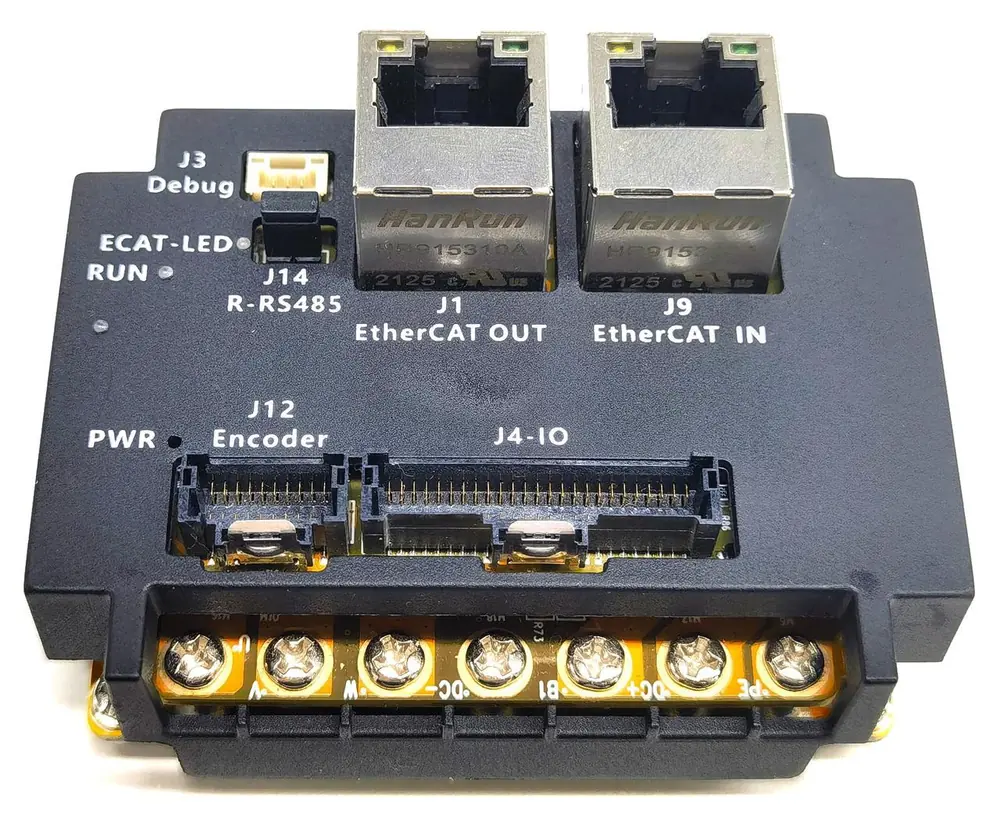
Every conversation about a servo drive eventually reaches the encoder, because the encoder is where position information enters the system and everything downstream inherits its limits. A 48 V DC servo drive regulates current on a low-voltage DC bus, and the current loop runs fast — current control frequency 20 kHz, maximum 40 kHz — so the drive is rarely the bottleneck in resolution. The feedback device usually is. On the drives I look after, the practical decision comes down to three questions: what resolution the mechanics can actually use, what the cable run will do to the signal, and whether the machine has to know where it is after a power cycle. Answer those three and the protocol list narrows quickly.Incremental quadrature and the 10 MHz ceiling
Incremental quadrature is the default and usually the right answer. The drive accepts differential quadrature up to 10 MHz, with single-ended wiring also available, and digital Hall as a single-ended signal for the simplest cases. The 10 MHz figure is the line frequency ceiling, not a resolution figure — the drive interpolates between counts, so the resolution you get depends on the encoder's line count and the interpolation inside the drive, while 10 MHz is about how much edge data the input can absorb before the cable and the receiver become the limit. Single-ended versus differential is a cabling decision, not a performance decision. Differential quadrature rejects common-mode noise and is what you want anywhere near a motor, a brake or a switching supply; single-ended is acceptable on short, quiet runs where cable cost matters. If position also has to reach a PLC or a vision system, the drive can output an equivalent encoder signal as single-end ABZ or differential ABZ at 0–5 V.The absolute protocols and where they are available
Absolute feedback changes one thing fundamentally: the drive knows where it is without a homing move, and it survives a power cycle. On a 48 V DC platform that matters more than it does on a large AC machine, because the same low-voltage bus is what loses power when a fault clears. For a machine that must be re-established quickly after an interruption, an absolute encoder removes the homing routine from the recovery sequence entirely. The cost is a serial link, a cable with more conductors, and a resolution fixed by the encoder rather than increased by drive interpolation. The supported set is not the same on every model, so read the table below as the starting point and then check the model-specific entry.| Protocol | Documented on | Practical note |
|---|---|---|
| Incremental quadrature | UF, DS, DG and the G family | Differential up to 10 MHz; single-ended also available on the single-axis products |
| BiSS-C | UF, DS, DG and DR | Serial absolute; the DR ring unit accepts it on both channels |
| SSI | UF, DS, DG and DR | Simpler serial absolute, widely supported |
| EnDat 2.2 | UF, DS, DG and DR | High-resolution absolute; DR ring supports it on encoder 1 and encoder 2 |
| Tamagawa | UF, DS, DG and the G family | Common in Japanese equipment; the G core module ordering table specifies 26 bit and below |
| Nikon | UF, DS and some DG dual-encoder variants | High-resolution optical absolute encoders |
| Sine/cosine 1 Vpp | UF -AP models only | Analogue sine and cosine signals for the machine to work with |
| Digital Hall | UF family, the G core module and the DG dual-encoder variants | Single-ended signal; direction and rough position only |
Two options that are easy to miss
Two encoder options deserve a separate mention. 1 Vpp sine/cosine is available on the-AP models and is used where the machine wants the raw analogue sine and cosine signals rather than a digital stream — some metrology and inspection stages interpolate those signals themselves. Digital Hall, a single-ended signal, covers the cases where you only need direction and a rough position: fans, pumps, simple indexers. Neither option is exotic, but neither is on every model either, and specifying the wrong one costs lead time rather than money.
Where the supported set narrows
Protocol support is not uniform across the range, and this is where selection errors come from. The UF and DS single-axis products carry the widest list — incremental quadrature plus BiSS-C, SSI, EnDat 2.2, Tamagawa and Nikon absolute, with 1 Vpp sine/cosine on the-AP variants. The DG wide-temperature platform is the dual-encoder member of the DG family, and the split between its two channels differs by variant: on one, encoder 1 takes incremental or absolute and encoder 2 takes incremental quadrature with a digital Hall signal; on another, encoder 2 takes absolute instead. The DR ring product is different again — it is built around two absolute encoder channels, both accepting EnDat 2.2, BiSS-C or SSI, with no incremental option at all, plus an external encoder supply interface so the absolute position survives with the main supply down. On the smaller embedded core modules the written list is narrower — the G core module entry I quote from specifies Tamagawa at 26 bit and below — so read the model-specific table rather than assuming the flagship list carries over. Note also that the G family units are embedded modules rather than standalone drives, and the STO option is not part of the G family at all.
The selection sequence I use
The sequence is short, and it starts with the mechanics rather than with the encoder catalogue:- Fix the target: the resolution the mechanics can use, and whether position must survive a power interruption.
- Decide the feedback path: differential quadrature, 1 Vpp sine/cosine, digital, or serial absolute.
- Check the protocol against the exact model suffix, not against the family name — a letter in the model code can change the encoder options, the current sampling and the force resolution at the same time.
- Size the cable for the protocol: differential for quadrature, screened twisted pairs for serial.
- Confirm the environment. The DG wide-temperature family covers −40 to +70 °C, while the UF series is rated 0 to +45 °C, so a machine in a conditioned cabinet and a machine on a shop floor are not the same selection.
What I need from you before I quote an encoder
If you want a specific encoder option confirmed, send me the encoder part number and the mechanical target: resolution, cable length, and whether the machine must re-home after a power interruption. Add the ambient temperature range and whether the axis has to survive vibration, because that pushes the question towards the DG family rather than the UF. Encoder and cable selection documents are in the document library, and the model-by-model encoder options are on the model parameters page.Key takeaways
- Incremental quadrature up to 10 MHz is the default; differential wiring is a noise decision, not a performance one.
- Absolute protocols on the range are BiSS-C, SSI, EnDat 2.2, Tamagawa and Nikon, but the supported list differs by model — the DR ring unit is absolute-only, so check the exact suffix.
- Dual-encoder and battery-backed absolute positions exist on the DG and DR families for machines that must keep position through a power interruption.
Common questions
Which encoder types can a 48 V DC servo drive accept?
Incremental quadrature (differential up to 10 MHz, single-ended also supported), absolute BiSS-C, SSI, EnDat 2.2, Tamagawa and Nikon on the models that document them, 1 Vpp sine/cosine on UF -AP models, and single-ended digital Hall. The exact list depends on the model suffix, so send the encoder part number and I will confirm the match.
Do I need an absolute encoder if the machine re-homes every cycle?
Usually not. If the axis runs a homing routine at every start and nothing has to know its position during a power interruption, incremental quadrature is simpler and gives more headroom on the input frequency. Absolute feedback earns its place when recovery after a fault must be fast, or when re-homing is slow or unreliable.
Can one drive take two encoders?
Yes, on specific families. The DG wide-temperature platform is the dual-encoder member of the DG family, and the split between the two channels differs by variant: on one, encoder 1 takes incremental or absolute and encoder 2 takes incremental quadrature with a digital Hall signal; on another, encoder 2 takes absolute. The DR ring unit is built around two absolute encoder channels, both accepting EnDat 2.2, BiSS-C or SSI, plus an external encoder supply interface so the position survives with the main supply down. Other models take a single feedback channel.