Home / Applications / Linear XY stages and gantries with 48 V DC servo drives
Technical note
Linear XY stages and gantries with 48 V DC servo drives
Straightforward positioning work — judge these on repeatability and tuning, not on force.
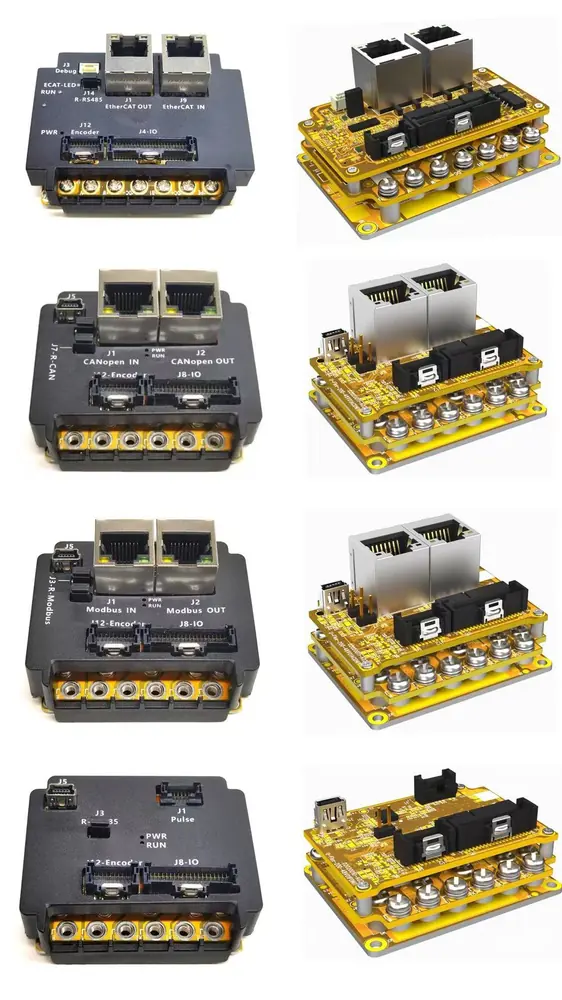
What the motion looks like
Planar positioning: fast traverse, controlled deceleration, and a settle that has to be fast enough to keep the cycle time but not so aggressive that the stage rings.Does it need force control?
Usually none. This is positioning work, and it should be judged on repeatability, settling and tuning stability rather than on force capability.What to look at in the specification
| Criterion | What to evaluate |
|---|---|
| Repeatability | ZR: rotational ±0.01°, linear ±2 μm |
| Settling time | Driven by inertia matching and gain tuning, not by force loop speed |
| Multi-axis synchronisation | EtherCAT bus cycle ≤ 4 kHz; DG3 ≤ 2 kHz |
| Trajectory handling | Multi-segment trajectory control built in across the range |
A selection checklist you can send to your engineer
Send this list to whoever is doing the mechanical work. If the answers come back with specific numbers rather than adjectives, the drive selection is half done — and so is the quotation.- Repeatability
ZR: rotational ±0.01°, linear ±2 μm - Settling time
Driven by inertia matching and gain tuning, not by force loop speed - Multi-axis synchronisation
EtherCAT bus cycle ≤ 4 kHz; DG3 ≤ 2 kHz - Trajectory handling
Multi-segment trajectory control built in across the range
Common mistakes I see
- Buying force control because it is on the table. If the stage never touches the workpiece, the force specification is irrelevant and the position specification is everything.
- Ignoring the mechanical side. A drive cannot make a poorly matched stage precise — inertia ratio, rigidity and backlash will dominate any current loop advantage.
Cycle time and settling
Throughput on a planar stage is set by the traverse speed, the deceleration profile and the settling time, and those three trade against each other: a faster traverse means a harder deceleration, and a harder deceleration excites the mechanics, which lengthens the settle. This is the classic case where the drive's motion features earn their place. Multi-segment trajectory control moves the trajectory handling into the drive firmware, shortening the loop between command and output, and a smooth multi-segment profile avoids the jerk that excites the frame. Both effects show up as a shorter time to a stable position rather than a higher top speed.Where I would start
Starting point: DS1 or DG3 depending on temperature; G-series six-axis for a gantry.. That is a starting point, not a finished selection — the deciding inputs are the motor model, the bus interface, the payload or stroke, the axis count and the ambient temperature. The parameter reference lists what each family covers, and the documents library has the cable tables and application notes your engineer will want.Key takeaways
- Where I would start: DS1 or DG3 depending on temperature; G-series six-axis for a gantry.
- Compare the current-loop and sampling specifications, not the force headline — the force number alone does not decide these applications.
- If the axis never touches the workpiece, say so. Position-control criteria are the right ones to judge on.
- Send the checklist to your mechanical engineer before choosing a model — most wrong selections start as an incomplete brief.
Common questions
Is a 48 V DC servo drive the right choice for linear xy stages and gantries?
It depends on whether the axis makes contact and on the thermal environment. My starting recommendation for linear xy stages and gantries is DS1 or DG3 depending on temperature; G-series six-axis for a gantry. — but the motor model, payload, bus type and ambient decide it properly. Send me those four and I will give you a specific answer.
Do I need force control for this application?
Usually none. This is positioning work, and it should be judged on repeatability, settling and tuning stability rather than on force capability.
Can one drive cover several axes in this machine?
For synchronised axes on one bus, the G-series multi-axis units cover pairs and six-axis groups over EtherCAT. If the axes are independent, separate drives are usually simpler and cheaper. Tell me the axis count and which axes must move together.
Which communication interface should I specify?
EtherCAT if you have multiple axes that must move together, or if you need STO. Modbus-RTU or CANopen for simple point-to-point axes where the motion is self-contained. Pulse/direction when you are retrofitting into an existing controller. One warning worth repeating: STO exists on EtherCAT models only, so if your safety case needs it, that decision forces the bus choice.
How do I validate the choice before committing to a quantity?
Run the drive on your own part, not on a test piece. The ForceControl Application note in the documents library describes the setup, and the current-loop and sampling figures in the parameter reference tell you what to look for in the force signal at the moment of contact. If you would rather have someone look at your data with you, send me the traces.