Home / Applications / Electric grippers and end-effectors with 48 V DC servo drives
Technical note
Electric grippers and end-effectors with 48 V DC servo drives
Grip force is a current setting, which makes it a natural fit for current-based control.
What the motion looks like
A gripper is usually one or two axes that close onto a part and hold it. The interesting part is the transition from moving to gripping, and what happens when the part is the wrong size.Does it need force control?
Grip force is fundamentally a current setting, because the motor current sets the torque and the torque sets the grip force through the mechanism. This makes grippers one of the most natural applications for current-based control.What to look at in the specification
| Requirement | Drive implication |
|---|---|
| Defined grip force | Current regulation with a repeatable limit |
| Force limit on a wrong-size part | Current limit acting as a mechanical safeguard |
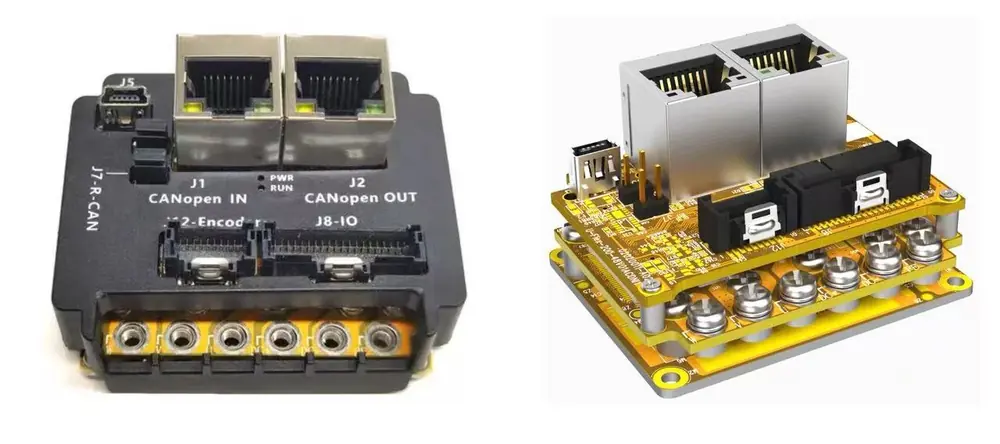
| Compact packaging | UF-…-AC / AM at 55 × 43 × 31.91 mm, 60.7 g |
| Two grippers on one controller | G-series dual-axis module if the axes must be synchronised |
A selection checklist you can send to your engineer
Send this list to whoever is doing the mechanical work. If the answers come back with specific numbers rather than adjectives, the drive selection is half done — and so is the quotation.- Defined grip force
Current regulation with a repeatable limit - Force limit on a wrong-size part
Current limit acting as a mechanical safeguard - Compact packaging
UF-…-AC / AM at 55 × 43 × 31.91 mm, 60.7 g - Two grippers on one controller
G-series dual-axis module if the axes must be synchronised
Common mistakes I see
- Treating grip force as a fixed number when the part tolerance is wide. Set the limit from the tightest acceptable part, not the typical one.
- Forgetting that a gripper axis is usually a short-stroke, high-force duty cycle — which is a duty-cycle question before it is a peak-current question.
Cycle time and settling
A gripper cycle is mostly mechanical, so the drive's contribution to cycle time is the time to reach and hold the grip force. If the grip axis has to retract before the transport axis starts, the two are usually sequenced by the controller, and the sequencing overhead often exceeds the motion itself at typical gripper speeds. Where synchronisation genuinely helps is a paired gripper — two jaws that must close together. A dual-axis module handling both on one bus removes the skew that a separately commanded pair can develop under load, and that skew is what actually causes dropped parts on a fast line.Where I would start
Starting point: UF series for a single gripper; G-series dual-axis for a synchronised pair.. That is a starting point, not a finished selection — the deciding inputs are the motor model, the bus interface, the payload or stroke, the axis count and the ambient temperature. The parameter reference lists what each family covers, and the documents library has the cable tables and application notes your engineer will want.Key takeaways
- Where I would start: UF series for a single gripper; G-series dual-axis for a synchronised pair.
- Compare the current-loop and sampling specifications, not the force headline — the force number alone does not decide these applications.
- If the axis never touches the workpiece, say so. Position-control criteria are the right ones to judge on.
- Send the checklist to your mechanical engineer before choosing a model — most wrong selections start as an incomplete brief.
Common questions
Is a 48 V DC servo drive the right choice for electric grippers and end-effectors?
It depends on whether the axis makes contact and on the thermal environment. My starting recommendation for electric grippers and end-effectors is UF series for a single gripper; G-series dual-axis for a synchronised pair. — but the motor model, payload, bus type and ambient decide it properly. Send me those four and I will give you a specific answer.
Do I need force control for this application?
Grip force is fundamentally a current setting, because the motor current sets the torque and the torque sets the grip force through the mechanism. This makes grippers one of the most natural applications for current-based control.
Can one drive cover several axes in this machine?
For synchronised axes on one bus, the G-series multi-axis units cover pairs and six-axis groups over EtherCAT. If the axes are independent, separate drives are usually simpler and cheaper. Tell me the axis count and which axes must move together.
Which communication interface should I specify?
EtherCAT if you have multiple axes that must move together, or if you need STO. Modbus-RTU or CANopen for simple point-to-point axes where the motion is self-contained. Pulse/direction when you are retrofitting into an existing controller. One warning worth repeating: STO exists on EtherCAT models only, so if your safety case needs it, that decision forces the bus choice.
How do I validate the choice before committing to a quantity?
Run the drive on your own part, not on a test piece. The ForceControl Application note in the documents library describes the setup, and the current-loop and sampling figures in the parameter reference tell you what to look for in the force signal at the moment of contact. If you would rather have someone look at your data with you, send me the traces.